 SPIKED
Field test
Two Years in a PEAX Dyneema Tipi with a Winnerwell Titanium Stove: The Honest Hot-Tent Review
The verdict
The best backcountry shelter system I've ever run — an about-7-lb hot tent that turns miserable trips into good ones — but it's for people willing to learn, not a pop-and-go system.
The night all my water froze
Picture a deer hunt, late season. Cold enough that every drop of water I hauled up the mountain froze solid overnight. Bottles, bladder, everything — bricks. So there I am, huddled over a Jetboil, feeding it chunks of my own ice just to get a drink of water. That was camping for me before the stove: shivering, thirsty, rationing fuel canisters, counting the hours until I could justify getting up.
Now? I’ve got a pot going all night. Coffee, then decaf teas, pot after pot, as much hot water as I want, burning wood that’s lying around free on the mountain. I honestly never use the Jetboil anymore — I carry one purely as a backup. The heat takes camping from a zero to a whole other world.
Two years ago I bought a PEAX Dyneema tipi and a Winnerwell titanium stove. It’s been on every trip since, and I’m going to tell you everything — including the time I folded the stove pipe in half, the daily maintenance that will literally keep you alive, and who absolutely should not buy this system.
One favor before we start: read this one all the way to the end. The cozy stories are up front, but the back half is where I hand you two years of lessons — and one habit back there could genuinely save your life. This is the best gear I can find, and the best gear deserves a fully briefed owner. Deal? Let’s go.
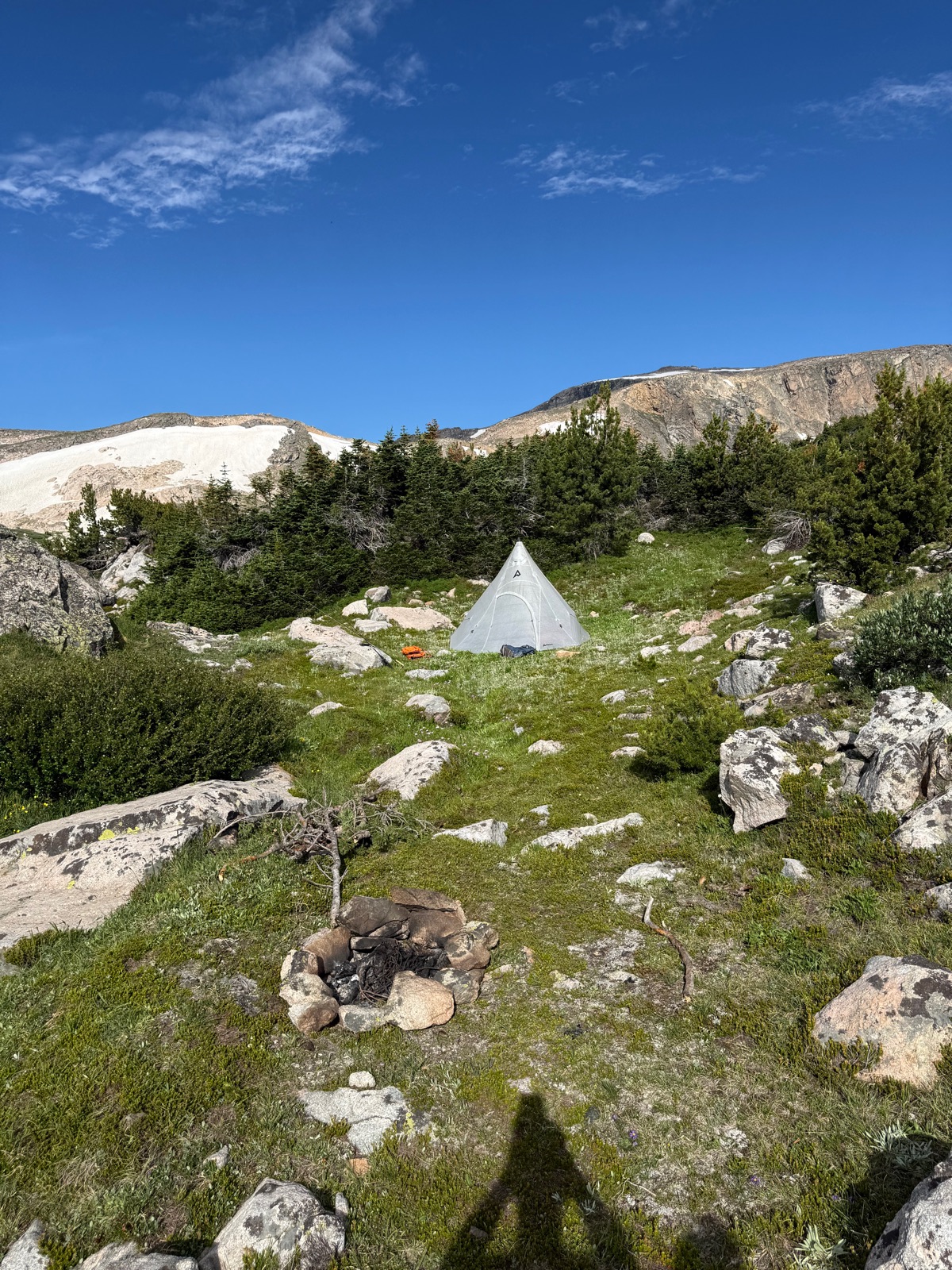 Home for the night: the Solitude 4 pitched in an alpine basin. Montana backcountry, two years of trips like this one.
What I run (and what it actually weighs)
- Shelter: PEAX Solitude 4 Tipi in Dyneema. Shelter body alone is right around 2 lbs (PEAX lists it at 1 lb 14.2 oz; packed weight with the carbon center pole, 12 stakes, cording, and bags is 3 lb 5.9 oz). Current price: $1,325. I ordered mine with no bug net and no floor — more on why below. It pitches off a carbon center pole, and trekking poles rig in alongside it for extra stabilization — they work together, not as a replacement.
- Stove: Winnerwell Fastfold Titanium 15-inch box stove — 4 lbs for stove + chimney, $599, with a 3-inch-diameter, 108-inch rolled pipe. I deliberately went with the bigger firebox: a longer box takes longer sticks, and longer sticks mean longer burns. One honest gripe: it burns great and it’s easy to run, but it doesn’t pack down as neatly as you’d hope — a little awkward in the pack. Still worth it, every trip.
- Pipe: the 9-foot chimney. That’s not overkill — a tall pipe puts the exit well above the tipi so hot ash isn’t raining down on your Dyneema.
- Whole system, real-world: about 7 lbs on my scale, everything included. Read that again. A heated, standing-height, four-person shelter for the weight of some solo tent-and-pad setups.
The tipi sleeps four with no gear, but realistically it’s two people plus gear plus the stove, and that’s how I run it.
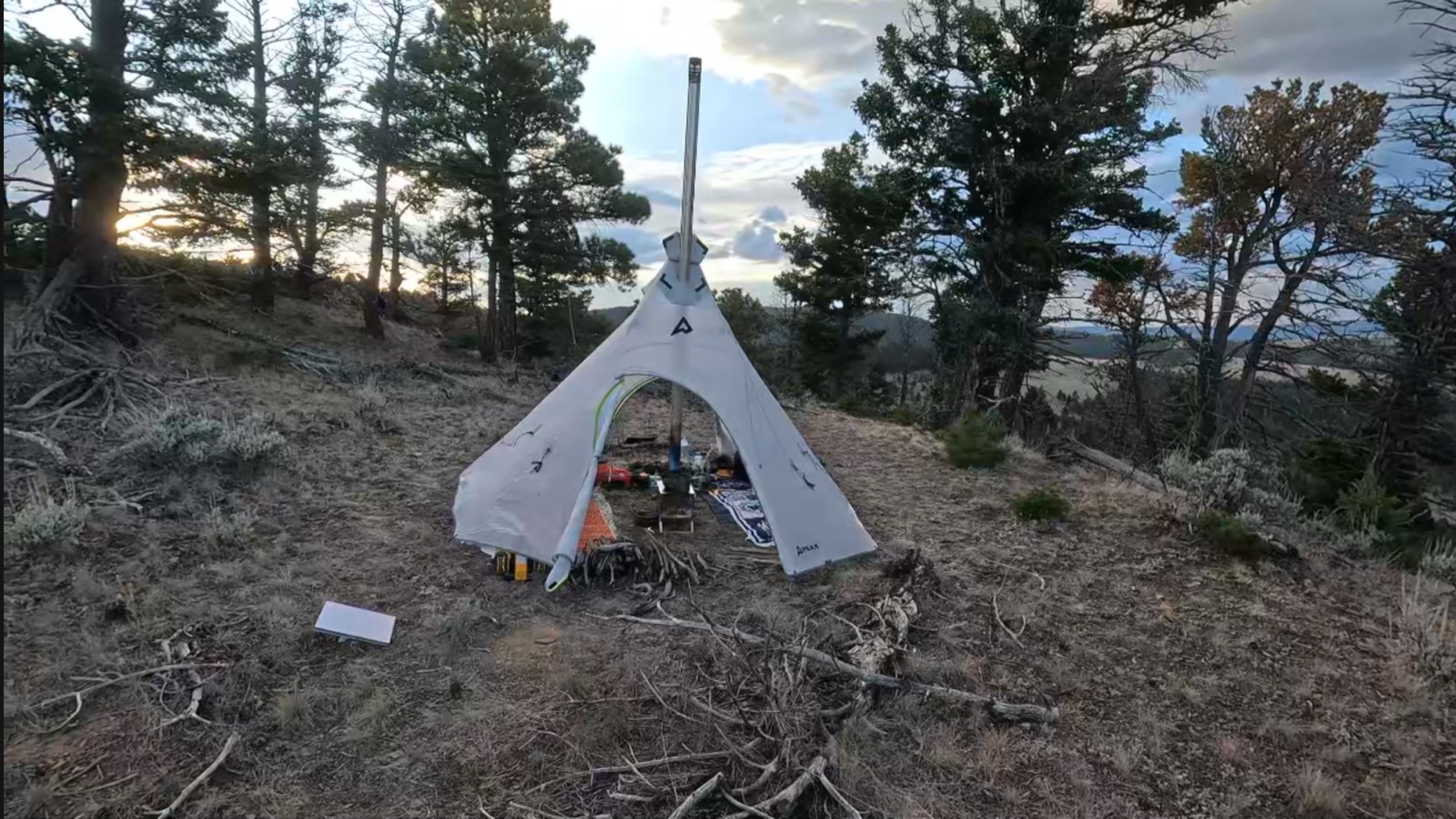 The system at work: stove burning, 9-foot pipe putting the exit well above the Dyneema.
Why Dyneema, or: the time I melted a KUIU tent
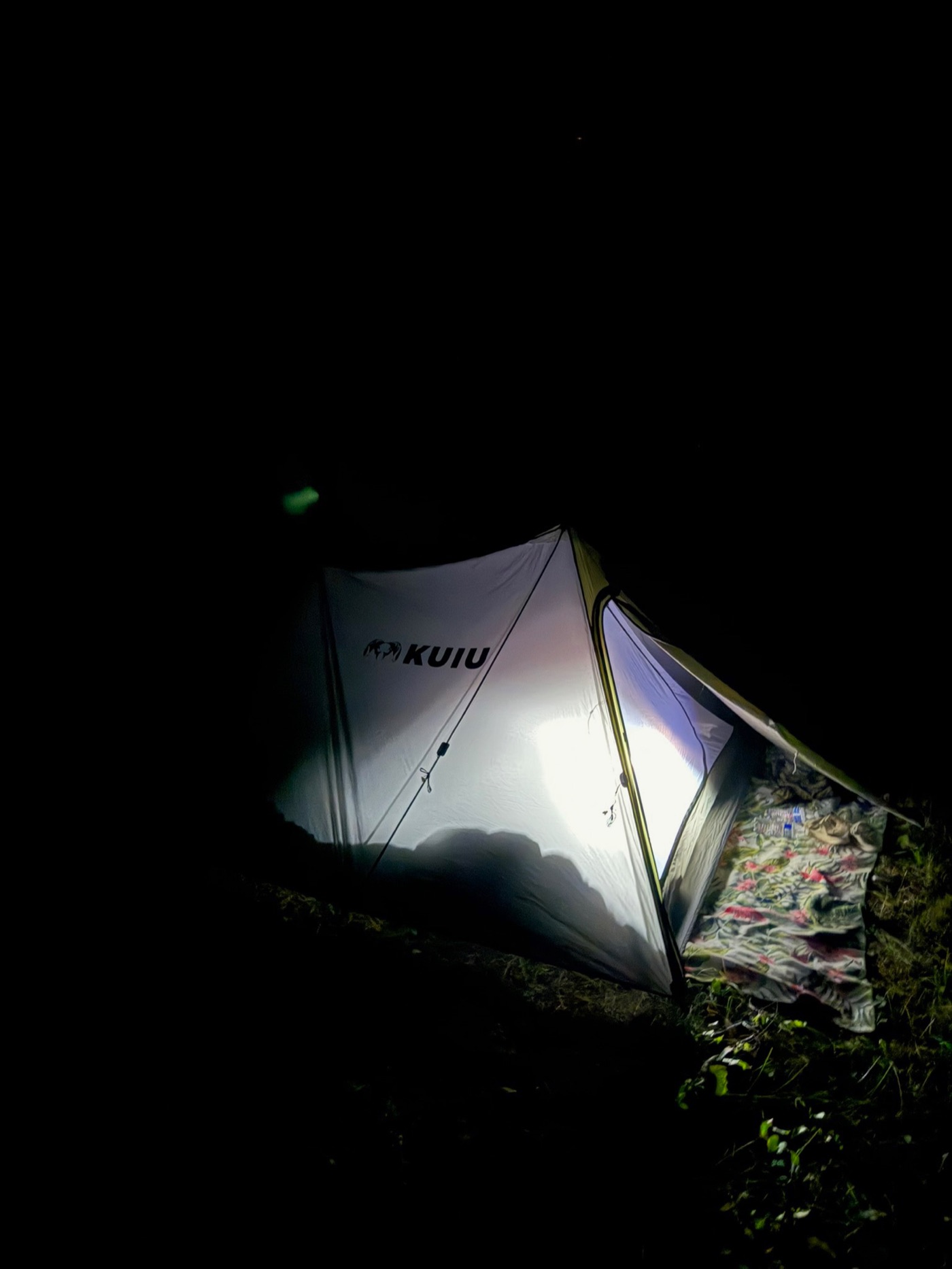 Exhibit A: the KUIU tent, back when it was still whole. Great tent. Wrong tool for a wood stove.
I didn’t start here. I started by running a wood stove in a KUIU tent, and I melted it. That’s the whole story — hot stove, wrong shelter, melted tent. That mistake is why I went to a purpose-built Dyneema tipi with a real stove jack, and it’s why I ordered mine with no netting and no floor: less material near the fire, less to melt, less to go wrong.
Two years and every single trip later: nothing better. No comparison. The other tipis that can match this durability are ten times the weight. Dyneema doesn’t stretch, doesn’t sag when it’s wet, and shrugs off wind that would have flattened my old setups.
What makes it unbeatable
The heat changes everything
My buddy is a cold-weather mule deer hunter — the kind of guy who’s spent his share of miserable frozen nights on purpose. He came out with me and this system and called it the most comfortable trip he’s ever had.
Better story: my girlfriend’s dad was basically done with camping. Age, cold, misery — he’d written it off. We got him in the tipi with the stove cranking, no bugs, and unlimited hot tea, and it completely turned him around. That’s what this thing does. It doesn’t make camping slightly nicer. It takes camping from a zero for somebody and puts them back on the mountain.
The stove is also your bug control
This one surprised me. Mosquitoes and flies get in the tipi, sure — mine has no net. But a stove-warmed tipi is a far less buggy tipi than you’d expect: get the fire going and the problem largely takes care of itself. Come back to camp and the tent’s full of flies? Boil water for a few minutes. Bugs handled.
That said, I do want to try the PEAX Half Nest with this setup — it’s a half-footprint bug nest insert (22 oz, $260, silnylon tub with no-see-um mesh) that covers the sleeping side and leaves the stove side open. PEAX says it works with a stove; my only hesitation is mesh anywhere near that pipe, because I’ve already melted one tent in my life and I’m not looking for a rematch. My untested working theory: with the nest installed, I’d run the stove cooler — keep it well under max temp so there’s more margin for error. That’s the whole philosophy of this system anyway: think about how you’re using it. I’ll report back.
Water on demand
I already told you about jet-boiling my own frozen water. The stove ends that era permanently. Snow becomes water, ice becomes coffee, evenings become pot-after-pot tea sessions. Your fuel is free and it’s lying all over the ground.
The drying room you carry at six pounds
This might be the most underrated thing the system does: the ability to dry things out is life-changing. Wet boots, soaked socks, sweated-out base layers, rain gear that got tested for real — hang it in a stove-warmed tipi and it’s dry by morning. In a normal tent, wet gear at dark is wet gear at dawn, and wet gear in the cold is how trips end early and how feet get wrecked. In this one, a soaked day is just a story you tell while your boots steam next to the stove. Day two starts dry. That changes what weather you’re willing to hunt through, which changes how much mountain you actually get to use.
The honest learning curve (read this part twice)
Here’s where I lose the people who wanted a five-star fluff review. This system has a real learning curve, and part of it is life-or-death serious.
Clean the spark arrestor EVERY day
Non-negotiable. The spark arrestor on top of the pipe clogs with creosote and ash. If it clogs, your draft dies — and a stove with no draft backdrafts, pushing smoke and carbon monoxide back down into the tipi instead of up the pipe. Carbon monoxide is the quiet one: no smell, no taste, no warning, and if it builds while you’re asleep, you may simply not wake up. That’s the honest worst case, and it’s why this section exists.
Now the part that should reassure you: this risk is entirely in your control. A clean arrestor drafts; a drafting stove sends everything up and out. One minute of maintenance a day removes the failure mode completely. People run hot tents safely all winter, every winter — it’s absolutely doable. It just isn’t optional. Clean it every single day. No exceptions, no “it looks fine.”
I grew up running a wood stove at home, so I understand backdraft in my bones. If you’ve never operated a wood stove, respect that gap and close it before you sleep next to one.
And back the habit with hardware: bring a carbon monoxide detector. A small battery-powered CO alarm weighs a few ounces and stands watch while you sleep — the exact hours you can’t watch the stove yourself. The daily arrestor cleaning removes the failure mode; the detector is the smoke alarm behind it. For a few ounces and a few dollars, there’s no version of this math where you leave it home.
My insurance policy: sleep low, face out
Even with a clean arrestor, I stack the odds. A floorless tipi doesn’t seal to the ground — there’s a gap all the way around the bottom edge, and the stove is constantly pulling fresh outside air in through it to feed the fire. So I sleep right up against the tipi wall with my face turned toward that floor gap, breathing the clean, cold air sliding in from outside. The wall position does double duty: fresh air at my face, and maximum distance between my sleeping bag and a hot titanium stove — that’s a touch-test I never want to run. Smoke rises; I sleep where the good air is. Free habit, might save your life.
One more floorless detail: read the ground before you bed down. No floor means no bathtub — if you’re lying in a dip when the rain comes, the water pools up inside the tent with you. Pick or scrape a spot with a touch of high ground.
Burn-time truth
Anyone telling you their backpacking stove burns all night untouched is selling something. Real numbers from two years: 2 hours of solid heat-throwing coals is dependable. 3 hours is iffy. Anything past 2 hours takes dialed airflow and the right wood. You will wake up cold at 3 a.m. sometimes and either feed it or ride it out.
But here’s the advanced class, because heat-burn and coal-survival are two different games: learn to slow-burn the stove and the morning changes. My best result — damper choked down, airflow just barely alive, the right wood loaded long — is coals that were still alive after a full 8 hours of sleep, live enough to light the morning fire with no starter and no ceremony. The stove wasn’t heating the tipi at hour six; that’s not the claim. The claim is you wake up, crack the damper, feed it, and have flame in seconds while the other guy is still fumbling with a lighter in his bag. Banked coals are the difference between a morning fire and a morning project.
My dream project — future article, I promise — is an engineered 8-hour log: one log split in four, kindling core, fire starter set at the front, bundled so it burns back slowly all night. Plus a fast-heat morning log for the get-out-of-the-bag moment. I’m going to build and test these.
Want to see that test — or have something else you want field-tested first? Email questions@spikedadrenaline.com and tell me. This site is owner-operated: the emails come from us and get answered by us. Not spam. The rare kind of email you’ll actually want to open.
Fire discipline
Wrong wood snap-crackle-pops sparks out the pipe. In dry country, with wind ripping ashes down the mountain, that’s how you end up on the news. Wind and fire don’t mix. Pick your wood, watch your conditions, and know when the answer is “no fire tonight.”
Bottom line: this is experts-only gear, or at least committed-students-only. It is not a pop-and-go system. You gotta wanna learn and tinker. If that sentence excites you, keep reading. If it annoys you, skip to “Who should not buy this.”
The windstorm: my one failure, and it was my fault
Last summer I took my girlfriend out and camped in a wide-open spot on purpose — we wanted the breeze to keep mosquitoes down. I got lazy and didn’t stake out the stove pipe guy line. The wind came up out of nowhere, sudden and violent, gear flying around camp — and it folded my 9-foot stove pipe in half.
The tipi itself? Took the same wind and survived. The next night I moved us into a protected little cove, staked everything properly, and it was beautiful — the tent didn’t shake all night. Same tent, same wind country, different operator decisions.
That’s the doctrine I want you to take from this review: most negative reviews of this tent are user error. Mine included. The gear did its job; I didn’t do mine. Here’s what doing your job looks like:
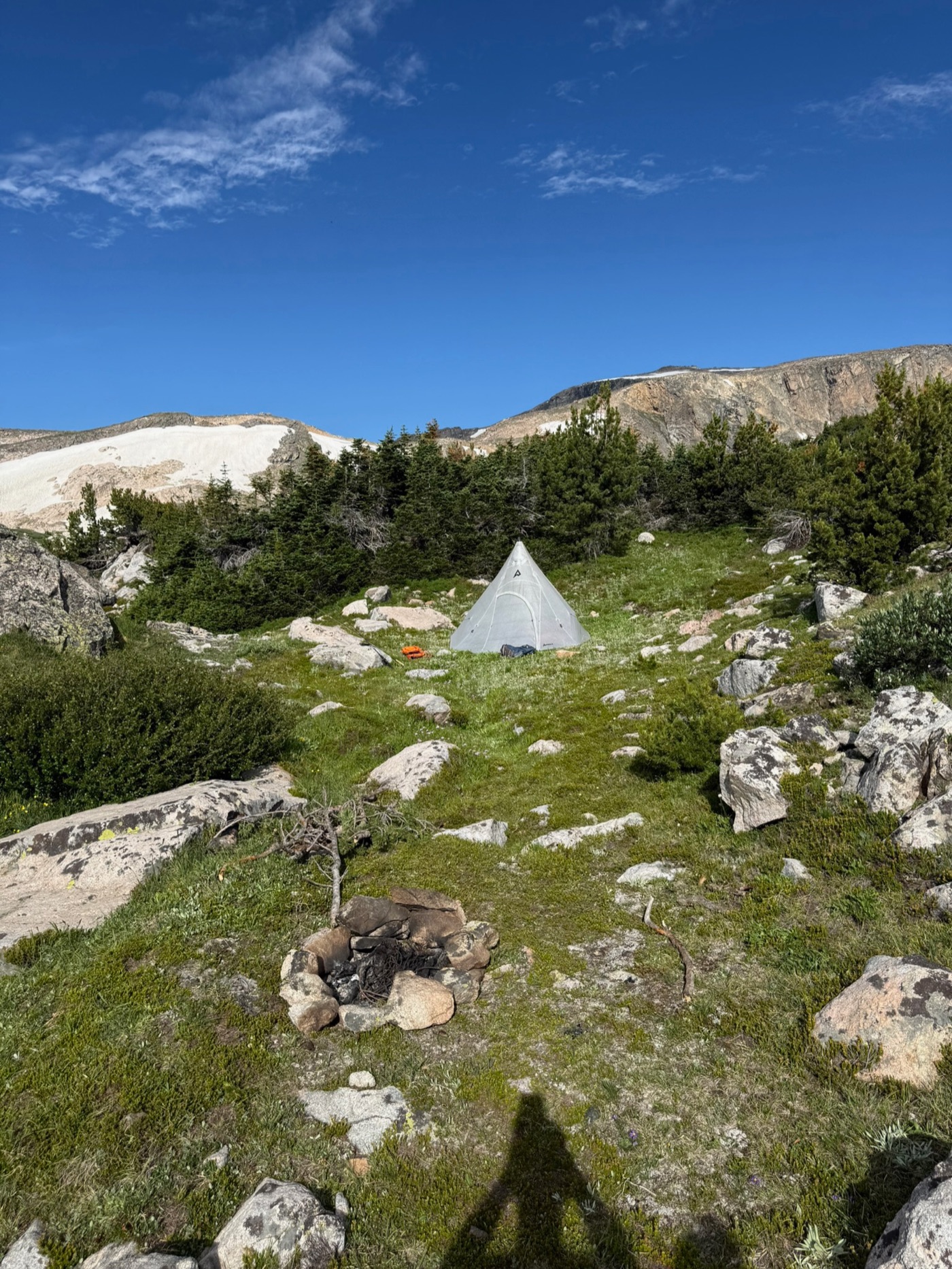 What doing your job looks like: flat bench, wind protection, established fire ring. The site is half the system.
- E-scout your site. Find a flat bench out of the wind before you ever leave the truck. Terrain is your first guy line.
- Stake it tight to the ground. No draft gap around the bottom edge. A loose pitch flaps, chills you, and feeds sparks oxygen. Dig or scrape a flat bed if you have to.
- Use the trekking-pole stabilization. The carbon center pole holds the tipi up; trekking poles rig in conjunction with it to brace the structure — and in wind country that combined skeleton is free insurance. The night I learned to use every stabilization point the system offers is the night the tent stopped shaking.
- Stake out everything, every time — including the pipe. Use a rock or hammer on the stakes. In snow, stake it like always, then bury the edges — packed snow seals the skirt and locks the pitch down better than stakes alone. It’s an upgrade on top of staking, not a replacement for it.
- Carry patches, always. My only damage in two years of hard use is one rub hole where a titanium stove corner rested against the Dyneema and sawed at it all night — my fault again. Field-patched it in minutes. Dyneema patches weigh nothing. Never leave without them.
Gear I’m still hunting for
The missing piece of this system is a true backpacking pickaxe for digging flat beds and fire pits — KUIU discontinued theirs and nothing has filled the hole. At the PEAX grand opening I got a look at a prototype on the bench in the test room: a pick on one side, a knife/saw on the other, built into a walking stick. Promising start.
Here’s the tool I actually want somebody to engineer — one head that does it all: pickaxe, walking stick, bino support, and shooting sticks. Dig your bed, hike in on it, glass off it, shoot off it. I’d honestly rather carry one solid cane-style walking stick than two trekking poles, and a multi-purpose head like that would end the debate for me. If that ships, it completes the kit. Watching this space closely — and if you know somebody building it, email us.
Who should NOT buy this
I mean this sincerely, not as reverse psychology:
- If you want pop-and-go, buy a freestanding tent. This system rewards tinkerers and punishes shortcuts.
- If you’ve never run a wood stove, don’t make a backcountry tipi your first one — or at minimum, burn it in your backyard for several nights first and learn the arrestor, damper, and draft cold.
- If you camp mostly in warm bug season and won’t carry the stove, you’re paying Dyneema prices for a tarp you’ll fill with mosquitoes. The fix isn’t a different tent — it’s mesh: add the Half Nest ($260) or PEAX’s full nest to the same tipi and you’ve got a legitimate bug-season shelter that’s still ready for the stove the day you are.
- If you won’t do daily maintenance, this stove can genuinely hurt you. That’s not marketing drama. Skip it.
- If $1,300+ for a shelter breaks the budget, PEAX makes the same tipi in silnylon for a lot less money and about a half pound more — that’s the smarter buy than stretching for Dyneema.
Verdict
Two years, every trip, one melted KUIU tent behind me and one folded stove pipe on my own scorecard: the PEAX Solitude 4 Dyneema tipi with a Winnerwell titanium stove is the best shelter system I have ever used, full stop. About 7 lbs buys you a heated, standing-height shelter, unlimited hot water, built-in bug incineration, and the kind of comfort that put my girlfriend’s dad back on the mountain. Nothing better. No comparison.
But it’s a system you operate, not a product you use. That’s not a flaw — for me it’s half the fun. I don’t test cheap gear; I test the best I can find, and dialing it in is the hobby inside the hobby. Learn the stove, clean the arrestor daily, pick your sites, stake it like you mean it, and carry patches. Do that, and you’ll wonder how you ever camped cold.
FAQ
How long does the stove actually burn? For heat: two hours of solid coals, reliably; three if the airflow and wood are dialed, and I’d call that iffy. Plan to feed it overnight or accept a cold stretch before dawn. But slow-burned right — damper way down, long wood — I’ve had coals survive a full 8 hours of sleep and light the morning fire on their own. Heat all night? No. Fire on demand at dawn? Absolutely learnable. The engineered 8-hour heat log is still the dream project.
Is it safe to sleep with the stove burning? It can be, if you treat it like the serious tool it is: spark arrestor cleaned daily, dry seasoned wood, damper set, and — my habit — sleep against the tipi wall with your face toward the floor gap, where the stove is pulling fresh outside air in low — right where your head is. Keep your bag well clear of the stove, too. And carry a small battery CO detector — ounces, dollars, and it watches the one failure mode you can’t. If any of that sounds like too much effort, let the fire die before you sleep.
Why no floor and no bug net? I melted a KUIU tent running a stove in it. Less flammable material near the fire is the whole design philosophy. Floorless also lets you dig a flat bed and keeps that life-saving fresh-air gap at the skirt — just don’t bed down in a dip where rainwater can pool. A warm stove keeps bug pressure surprisingly low on its own. I may add the PEAX Half Nest ($260 — bug mesh over the sleeping half only) and will report how it lives next to a stove.
Dyneema or silnylon? Dyneema if the budget allows: no stretch, no sag when wet, absurdly strong for under 2 lbs. Mine survived a windstorm that folded a titanium stove pipe in half. But it’s a big price jump for roughly half a pound, so silnylon is the rational pick for most people. Either way the failures you read about in reviews are mostly user error — bad sites and lazy stake-outs — not fabric.
Why the 9-foot pipe instead of something shorter? Height. The exit sits well above the tipi, so sparks and hot ash burn out or blow clear instead of landing on your shelter. After the melted-tent incident, I don’t compromise here. Just stake the pipe’s guy line — ask me how I know.
Can one person carry the whole system? Yes. Tipi packed with pole and stakes is about 3.5 lbs, stove and pipe about 4 lbs — my whole real-world system is about 7 lbs. Split between two hunters it disappears entirely.
Got a question we didn’t cover? Email questions@spikedadrenaline.com — we answer every one ourselves. Not an outsourced help desk, not a bot. The same people who packed this gear into the backcountry. That’s the whole point of this site.
Reader-funded
Keep the tests coming
No sponsors. No ads. No affiliate strings — yet. Every review here is bought with our own money and tested on our own miles. If one saved you from an expensive mistake — or talked you into the right one — the tip jar keeps the next field test funded.
Fuel the next field test ☕Newsletter
More verdicts like this
Join the list and get every new field test the day it publishes.